The First Peoples — Pericú and Guaycura
Long before any Spanish ship crossed the Gulf of California, the La Paz region was home to the Pericú and Guaycura peoples — small, mobile groups who lived by hunting, gathering, and fishing along the Gulf coast and in the nearby sierras. Their languages, spiritual traditions, and rock art distinguish them from the more well-known Indigenous civilizations of central Mexico; they were peoples adapted to an arid, sea-abundant peninsula, living lightly on a landscape that demanded ingenuity and resilience.
Rock art and artifacts scattered across the surrounding desert and sierras still offer glimpses of their way of life. Both groups were largely displaced or assimilated into the colonial mission system by the late 18th century — a rapid and devastating transformation triggered by European contact, introduced disease, and forced settlement.
Hernán Cortés and the Naming of La Paz
In April–May 1535, Hernán Cortés himself led an expedition across the Gulf of California and landed in the bay now known as La Paz. He formally claimed the land for Spain and founded a small settlement he called Santa Cruz — one of the first European outposts on the Baja California peninsula. The attempt was short-lived. Fresh water was scarce, relations with the Indigenous Pericú were hostile, and supply lines from the mainland proved unreliable. The colony was abandoned within a few years.
The name “La Paz” — The Peace — came later, expressing the Spaniards' hope for a more stable and peaceful outpost along the Gulf coast. The aspiration proved more durable than the original settlement: La Paz endured as a place name and eventually as a city of genuine significance.
Missions and Spanish Control
Permanent Spanish presence in southern Baja did not take hold until the late 17th century. The Jesuits founded the first lasting mission in the region at Loreto in 1697, establishing a foothold from which missionaries expanded steadily southward. The mission system — first Jesuit, later Franciscan and Dominican — brought Spanish agriculture, livestock, Christianity, and European disease to Indigenous communities across Baja California Sur, integrating them into mission-centered settlements that formed the nuclei of later towns.
The missions also laid the foundation for La Paz's eventual rise as an administrative center, establishing the patterns of land use and settlement that would shape the region for centuries.
The Pearl of the Pacific
The waters of La Paz Bay had been prized for natural pearl oysters long before the Spanish arrived — Indigenous communities harvested them for adornment and trade. After colonization, pearling became the defining economic activity of La Paz for several centuries.
Small boats worked the bay each year from May to September, with Indigenous divers descending bareback to pry open oyster shells, sometimes at considerable personal risk. The trade made La Paz famous across the Spanish Empire, earning it the nickname “La Perla del Pacífico” — the Pearl of the Pacific. The title reflects not just the literal harvest of the bay, but the city's reputation as the most refined and prosperous settlement on the Baja peninsula during its pearling heyday.
Natural pearl stocks eventually declined — exhausted by centuries of harvest and devastated by a blight in the early 20th century that wiped out the remaining oyster beds. The industry that had defined La Paz for 300 years effectively ended. The city's identity, however, had been shaped by it permanently.
Silver, Gold, and the Mining Era
During the 18th and 19th centuries, discoveries of silver and gold in the mountain towns of El Triunfo and San Antonio — perched in the Sierra de la Laguna foothills southeast of La Paz — briefly transformed Baja California Sur into a destination for prospectors and capital from across Mexico and beyond.
At its peak in the late 19th century, El Triunfo was the most populous and prosperous town in all of BCS — home to more than 10,000 residents, a smelter chimney stack that still stands today, and a level of cultural and commercial activity that made La Paz (as the nearest port and supply hub) feel almost cosmopolitan by comparison. The mines closed in 1926 as the veins played out. Most residents left. What remained were empty haciendas, a haunting chimney, and a colonial legacy that visitors can still explore on day trips from La Paz.
Capital of Baja California Sur
Baja California Sur became Mexico's 31st state in 1974, and La Paz was designated its capital — a recognition of the city's historical role as the administrative, commercial, and cultural center of the peninsula's southern half. Its existing port infrastructure, central Gulf-coast location, and long history as a regional hub made it the natural choice.
The state's creation brought federal investment, university development (the Universidad Autónoma de Baja California Sur was established in the same era), and an administrative apparatus that helped anchor La Paz as a city of real institutional weight — distinct from the more resort-oriented municipalities of the Cape region.
Hurricanes and Resilience
La Paz sits in a hurricane-prone corridor of the Gulf of California, and major storms have periodically reshaped the city's development. Hurricane Odile in 2014 — one of the most powerful storms ever to strike the Baja California peninsula — caused significant damage to buildings and infrastructure throughout BCS, serving as a stark reminder of the region's meteorological vulnerability.
The experience prompted updated building codes, coastal-zone planning reviews, and a renewed focus on disaster preparedness that continues to influence how La Paz grows. The city's response to Odile also reinforced something already present in its character: a community that rebuilds, adapts, and takes its position on the edge of nature seriously.
La Paz Today
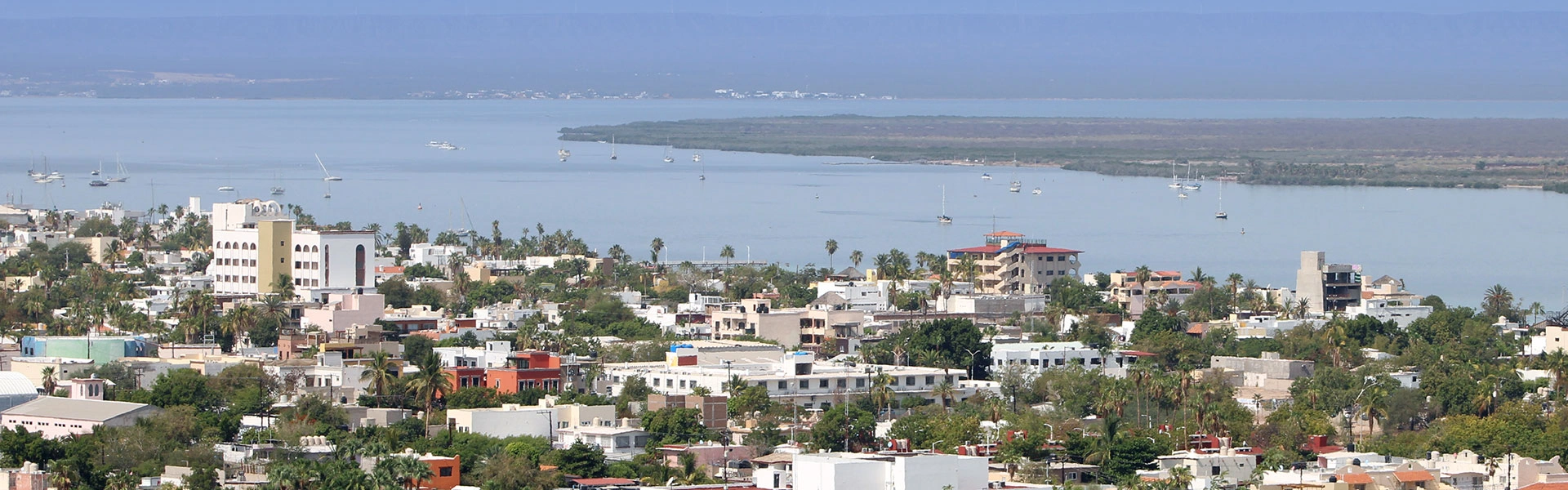
Today, La Paz is a mid-sized Gulf-coast capital whose municipality is home to about 321,000 people (CONAPO 2026 projection) — functioning as a hub of commerce, government, education, and a growing ecotourism economy. The Universidad Autónoma de Baja California Sur gives it a younger, more intellectual energy than most peninsula cities of comparable size. The bay that made it famous as a pearl-diving center now draws kayakers, whale-shark swimmers, sailors provisioning for Pacific crossings, and expats seeking the combination of urban amenities and natural proximity that is increasingly hard to find anywhere in Mexico.
La Paz vs. Los Cabos
The comparison is inevitable, and the contrast is stark. Los Cabos — the municipality that includes Cabo San Lucas and San José del Cabo — is built around high-end resort tourism, golf courses, cruise ship traffic, and international nightlife. It is a world-class tourist destination and a genuinely impressive one. It is also, for many people, a lot.
La Paz offers something different: a slower pace, a stronger local identity, lower costs, and access to some of the same extraordinary natural environment — the Sea of Cortez, Espíritu Santo, whale sharks — without the resort overlay. Travelers and expats who discover La Paz tend to feel that they've found something the brochures haven't caught up with yet. That feeling, accurate or not, is part of what makes the city what it is.