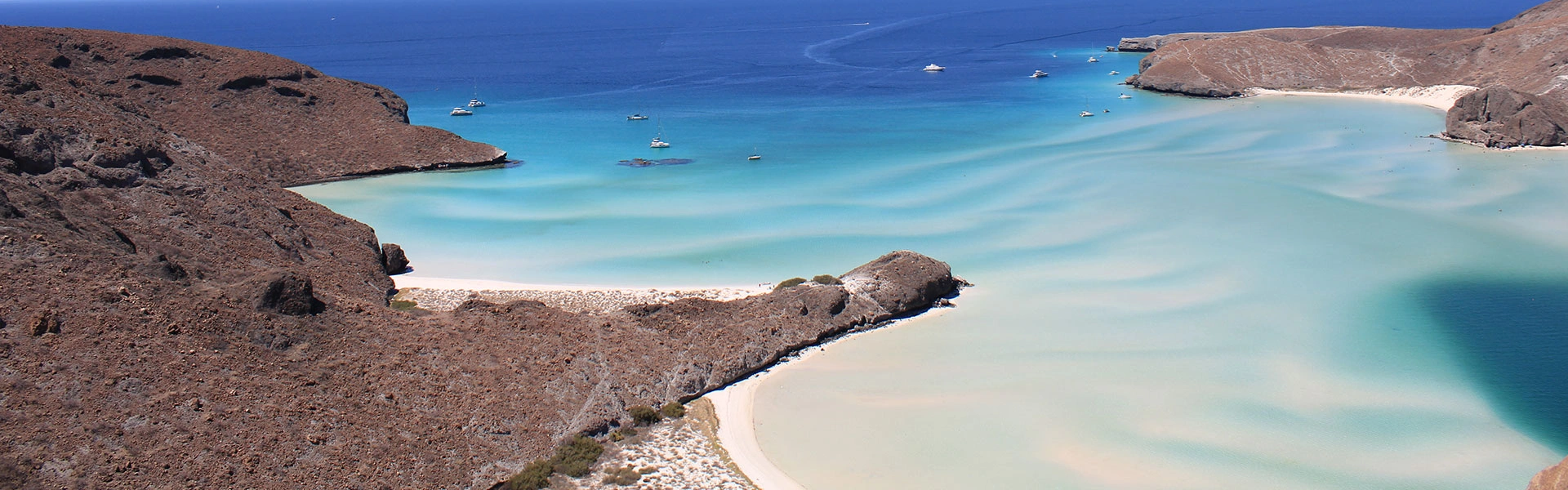
Espíritu Santo Island Guide
Espíritu Santo Island is La Paz’s most iconic eco-adventure — part of the UNESCO World Heritage-listed Gulf of California islands, where desert cliffs, turquoise water, and a thriving sea lion colony coexist under some of Mexico’s strictest marine protection rules. It’s approximately 35 km northeast of La Paz and about one hour by boat from the marina.
Island Overview
Location
~35 km northeast of La Paz
Boat Ride
~1 hour from Marina ASIPONA
Size
31 sq miles (80 km²)
Status
Uninhabited marine national park
UNESCO
Gulf of California Islands (2005)
Sister Island
Isla Partida (connected by canal to north)
Espíritu Santo is managed by CONANP under the Espíritu Santo Archipelago Marine National Park designation (created 2007). The island is uninhabited and permanently protected — visitors are guests in an active marine ecosystem. All access requires a CONANP park bracelet, and all sea lion activities must be conducted through licensed, permitted tour operators.
On the Map
The Sea Lion Experience — Los Islotes
Los Islotes is a rocky outcrop at the northern tip of the archipelago, home to the largest California sea lion colony in the Gulf of California — approximately 800 individuals. It’s one of the few colonies in the Sea of Cortez actively growing in size, attributed to the tight regulations governing visitor access.
Swimming with sea lions is permitted only through authorized, licensed operators. The experience — particularly between January and April during pup season — is genuinely remarkable: juvenile sea lions are curious, playful, and will swim directly up to snorkelers. Adult behavior tends to be more passive, though bulls can be assertive near the rocks.
Los Islotes Closed June 1 – August 31
The entire zone around Los Islotes and El Refugio is closed to all visitors — including swimming, snorkeling, and diving — from June 1 through the end of August. This is a full zone closure, not just a sea lion swimming restriction. It corresponds to the sea lion mating, birth, and breeding season. The island itself remains visitable; operators take guests to alternative snorkeling sites during the closure.
Always confirm sea lion access status with your operator before booking any trip between June and September.
Year-Round Rules at Los Islotes
- •Always remain at least 15 feet from the rocks of Los Islotes — do not set foot on them
- •Do not touch sea lions, birds, or fish
- •Freediving at Los Islotes is not permitted — snorkeling only at the rookery area
- •Scuba diving is restricted to designated dive sites outside the rookery
- •Snorkeling visits are limited to 1.5 hours; dive visits to 3 hours
- •Life jackets are required for snorkelers
- •Mooring buoys are for licensed operator vessels only (30 feet or under)
Best Time to Visit
October through May is the recommended window for the full Espíritu Santo experience. November through April is the sweet spot — comfortable temperatures, excellent water visibility, and sea lion access. January through April is pup season at Los Islotes, when juvenile sea lions are at their most playful and interactive.
| Period | Conditions | Sea Lions | Notes |
|---|---|---|---|
| Oct – Nov | Warm, clear water, fewer crowds | Open | Great shoulder season — whale shark season opens October 1 |
| Dec – Feb | Cooler (60–75°F), calm, dry | Open | Whale watching season nearby; pup season begins January |
| Mar – May | Warming up, excellent water visibility | Open | Best overall — Jan–Apr pup season brings most playful juveniles |
| Jun – Aug | Hot (90°F+), some rain, summer winds | Closed | Los Islotes closed. Mobula rays, blue-footed boobies, sea turtles still visible |
| Sep | Transitional, hurricane risk fading | Closed | Closed until September 1. Some operators resume late in the month |
Summer is not a wasted trip — it’s just a different experience. Mobula ray aggregations in July–August are spectacular. Blue-footed boobies, sea turtles, and frigatebirds are more visible. Kayak camping remains excellent. The flagship sea lion encounter is simply unavailable, and heat and occasional rain are real factors.
Kayaking and Camping
Espíritu Santo is one of Baja’s premier multi-day kayak destinations. Its protected coves, calm inner bay waters, and series of white-sand beaches make it ideal for motor-supported paddling trips and fully self-sufficient expeditions. A CONANP camping permit is required to stay overnight, and visitors must practice strict leave-no-trace principles.
Bahía San Gabriel
Most protected cove, easiest access from La Paz. Note: anchoring is entirely prohibited in San Gabriel Bay.
Playa Ensenada Grande
The island's most iconic beach — long white sand framed by dramatic cliffs. Popular for day trips and camping.
Playa La Raz
Quieter beach popular with independent campers. More solitude, similar scenic quality.
For first-time visitors, a guided kayak camping trip with a licensed operator is strongly recommended. Operators handle permits, logistics, safety equipment, and navigation — and their local knowledge of conditions, anchorages, and wildlife timing significantly improves the experience.
Park Passes and Fees
A CONANP park bracelet is required to enter the protected area — for anchoring and going ashore. The current day pass is approximately 150 MXN (~$7–8 USD) per person, though fees adjust periodically and should be confirmed with your operator or directly with CONANP.
Day Pass
~150 MXN (~$7–8 USD). Usually included in tour price or collected at the dock. Confirm when booking.
Annual Conservation Passport
Valid for all Mexican protected areas including Loreto Bay and Revillagigedo. Available at the La Paz CONANP office or via the Pasaporte de la Conservación app.
A valid passport is required for international visitors when purchasing in person at the CONANP office. Possible exemptions for children under 12 and seniors over 60 — verify with the operator.
Anchoring Rules for Private Vessels
- •Los Islotes: No overnight anchoring
- •San Gabriel Bay: Entire bay closed to anchoring
- •North of Bonanza: Bay open to anchoring; reef area to the north is closed
- •Park pass required for anchoring and going ashore
Park rangers can be reached at 612-128-4141 ext. 18120 or VHF Channel 16 for emergencies or rule clarifications.
Visitor Rules
Do
- ✓Use a licensed, permitted tour operator
- ✓Wear your CONANP park bracelet at all times
- ✓Stay on designated trails when ashore
- ✓Snorkel within the 1.5-hour time limit at Los Islotes
- ✓Pack out all trash — leave no trace
- ✓Keep 15+ feet from the rocks of Los Islotes
Don’t
- ✗Step onto Los Islotes rocks — even standing in the water near them
- ✗Touch sea lions, birds, fish, or coral
- ✗Take shells, rocks, coral, or any natural material
- ✗Freedive at Los Islotes (snorkeling only at the rookery)
- ✗Use jet skis, water skis, or similar equipment in the park
- ✗Anchor in closed zones (San Gabriel Bay, Los Islotes overnight)
- ✗Fish without a license
Want to do more than leave no trace? Mar Libre, a La Paz volunteer group, cleans a reef or mangrove every month and posts each cleanup on its Facebook page.
Frequently Asked Questions
Can I visit Espíritu Santo Island on my own without a tour?
Technically yes if you have your own vessel and a CONANP park pass — but for most visitors, a guided tour is the practical and recommended approach. Licensed operators know the rules, have the required permits, handle the park bracelet, and take you to the best sites. Solo kayak camping is possible but requires preparation and a camping permit from CONANP.
When is sea lion swimming at Los Islotes closed?
The Los Islotes zone is closed to all visitors — swimming, snorkeling, and diving — from June 1 through the end of August (officially June 1 – September 1 per CONANP rules). This corresponds to the sea lion mating, birth, and early rearing season. The island itself remains visitable; operators run alternative snorkeling sites during the closure. Always confirm current status with your operator before booking a summer trip.
How long is the boat ride from La Paz to Espíritu Santo?
Approximately one hour from the main La Paz departure points, including Marina ASIPONA. Travel time varies depending on vessel speed and conditions in the channel.
Do I need a park pass, and is it included in tour prices?
Yes. A CONANP park bracelet is required to enter the protected area and go ashore. The current day pass is approximately 150 MXN (~$7–8 USD) per person. Many tour operators include it in their price or collect it as a separate day-of fee — confirm when booking. Annual conservation passports are also available through CONANP or the Pasaporte de la Conservación app, and are valid across multiple Mexican protected areas.
Can I camp on Espíritu Santo Island?
Yes — camping is permitted at designated beaches with a CONANP camping permit. Popular spots include Bahía San Gabriel, Playa Ensenada Grande, and Playa La Raz. Visitors must practice strict leave-no-trace principles. Guided multi-day kayak camping trips with licensed operators are the safest and most practical option for first-time visitors.
Is it safe to kayak around Espíritu Santo?
With proper preparation and conditions awareness, yes. The island's inner coves offer calmer water than the open Gulf, and it's one of Baja's premier kayak destinations. Weather and wind patterns matter — summer brings higher winds and occasional chop. For multi-day trips, working with a licensed outfitter for a motor-supported or guided expedition is strongly recommended.
What marine life can I see besides sea lions?
The waters around Espíritu Santo are extraordinarily rich. Year-round: tropical fish, parrotfish, eels, rays, sea turtles. Seasonal highlights: mobula rays aggregate in July–August in spectacular numbers; whale sharks pass through (Oct–May, centered on the wider La Paz Bay area); dolphins are frequently seen; blue-footed boobies, frigatebirds, and brown pelicans are resident on the rocks.
What is the difference between Espíritu Santo Island and Los Islotes?
Espíritu Santo is the main island — 31 square miles of desert cliffs, coves, and beaches. Los Islotes is a small rocky outcrop at the northern tip of the Espíritu Santo archipelago, about 30 minutes by boat beyond the main island. Los Islotes is home to the sea lion colony and is the signature snorkeling destination, but it operates under stricter rules than the rest of the island due to the colony's sensitivity.